
- Education Topics
- Achievement Gap
- Alternative Education
- American Education Awards
- Assessment & Evaluation
- Education during COVID-19
- Education Economics
- Education Environment
- Education in the United States during COVID-19
- Education Issues
- Education Policy
- Education Psychology
- Education Scandals and Controversies
- Education Reform
- Education Theory
- Education Worldwide
- Educational Leadership
- Educational Philosophy
- Educational Research
- Educational Technology
- Federal Education Legislation
- Higher Education Worldwide
- Homeless Education
- Homeschooling in the United States
- Migrant Education
- Neglected/Deliquent Students
- Pedagogy
- Sociology of Education
- Special Needs
- National Directories
- After School Programs
- Alternative Schools
- The Arts
- At-Risk Students
- Camps
- Camp Services
- Colleges & Universities
- Counties
- Driving Schools
- Educational Businesses
- Financial Aid
- Higher Education
- International Programs
- Jewish Community Centers
- K-12 Schools
- Language Studies
- Libraries
- Organizations
- Preschools
- Professional Development
- Prom Services
- School Assemblies
- School Districts
- School Field Trips
- School Health
- School Supplies
- School Travel
- School Vendors
- Schools Worldwide
- Special Education
- Special Needs
- Study Abroad
- Teaching Abroad
- Volunteer Programs
- Youth Sports
- For Schools
- Academic Standards
- Assembly Programs
- Blue Ribbon Schools Program
- Educational Accreditation
- Educational Television Channels
- Education in the United States
- History of Education in the United States
- Reading Education in the U.S.
- School Grades
- School Meal Programs
- School Types
- School Uniforms
- Special Education in the United States
- Systems of Formal Education
- U.S. Education Legislation
- For Teachers
- Academic Dishonesty
- Childcare State Licensing Requirements
- Classroom Management
- Education Subjects
- Educational Practices
- Interdisciplinary Teaching
- Job and Interview Tips
- Lesson Plans | Grades
- Professional Development
- State Curriculum Standards
- Substitute Teaching
- Teacher Salary
- Teacher Training Programs
- Teaching Methods
- Training and Certification
- For Students
- Academic Competitions
- Admissions Testing
- At-Risk Students
- Career Planning
- College Admissions
- Drivers License
- Educational Programs
- Educational Television
- High School Dropouts
- Higher Education
- School Health
- Senior Proms
- Sex Education
- Standardized Testing
- Student Financial Aid
- Student Television Stations
- Summer Learning Loss


College of Architecture and Environmental Design / Kent State University
Basic Information
Address: 1309 Euclid Avenue, Suite 200
Cleveland, Ohio 44115
Phone Number: 330-672-2917
Email: CAEDgradprograms@kent.edu
Chair: Cat Soergel Marshall
Dean: Mark Mistur
Action Shots
Additional Information
Tuition:
At Kent State, tuition costs for Graduate students during the Fall and Spring Semesters are capped at an 11-credit total. Tuition rates are adjusted annually, with new rates posted in May. The following link to university-wide costs are provided to help you quickly estimate the cost of a degree in the College of Architecture and Environmental Design. https://www.kent.edu/tuition
In the CAED there is typically a program fee charged each semester you are studying with us. This program fee helps offset a variety of costs associated with access to our Labs, Computers, Equipment, and facilities. Depending on your Graduate Program, fees will vary. The costs associated with the Landscape Architecture Program is $700/semester of study.
All students enrolled must hold health insurance. Insurance rates typically increase annually, but you can get a reasonable estimate of your out-of-pocket costs by looking at the current rates. Proof of insurance is not mandatory for domestic students, but please take the necessary steps to ensure you are covered! You may also opt to purchase health insurance through the university.
Financial Aid:
Graduate Assistantships
Our College offers Graduate Assistantships (GA) annually for select students in all programs. All admitted applicants are AUTOMATICALLY considered for these GAs - no additional steps are required to apply. Graduate Assistantships cover either a partial or full tuition waiver for the semester awarded. Students typically receive GAs for alternating semesters in the program, and should therefore anticipate covering a portion of their tuition costs. During semesters of GAs, students also receive a GA stipend for responsibilities carried out in the areas of either research, teaching or administrative assistance (RA, TA or AA). Current stipends are normally $3000 per semester based on 10 hours of work each week for 15 weeks. Graduate Assistantship offers are typically issued between February and mid-March, to allow time to review all eligible students and allocate funding appropriately. Students offered GAs are normally given until mid-April to accept their offer. After that, another round of offers is released towards the end of April.
Scholarships
All students may search our Scholarship database to explore a range funding opportunities as soon as you have been admitted into the program. See: https://www.kent.edu/fbe-center/scholarship-universe . We also encourage international students to learn about scholarships available from their home countries that they may be eligible for, as these may not appear on our database.
Federal Loans: FAFSA
Unlike grants or scholarships, Federal student aid loans must be repaid. The Free Application for Federal Student Aid (FAFSA) form can be found at https://studentaid.gov/. Once you have completed the FAFSA, you become eligible for up to $20,500 in an unsubsidized loan for the academic year. The total amount awarded depends on a variety of factors. You can find more information at https://www.kent.edu/fbe-center/loans. You must remain enrolled a minimum at half-time to receive federal student loans (4 credit hours or more for graduate students). Unfortunately, International students do not qualify for federal loans.
Holistic Cost Considerations
When looking at the cost of attendance, particularly in comparison to other universities, students should factor in the cost of living in the Cleveland region and how this compares with other areas. We believe we are very cost-competitive relative to our peer institutions. We also support students in other ways - by subsidizing student travel opportunities, by hiring student workers as much as possible in a variety of roles, by offering a rich lecture series, and by offering excellent facilities and equipment. These resources serve our entire student population.
Additional Information
To receive more detailed information, please contact the Financial, Billing, and Enrollment Center to discuss your personal financial situation at https://www.kent.edu/fbe-center/scholarships-financial-aid. Here you will find information about FASFA, Cost of Attendance, and a Financial Aid Checklist. You may also schedule an appointment through: https://www.kent.edu/fbe-center/contact-us#schedule. There are also a variety of 'how to' videos found on their website see: https://www.kent.edu/fbe-center/how-videos.
Disability Services:
Student Accessibility Services (SAS)
Kent State University recognizes that the academic mission of this institution is to provide equal learning opportunities for every individual. Directly related to this endeavor is the need for protection against discrimination and the practices that may accompany it. University Policy 3342-3-01.3 requires that students with disabilities be provided reasonable accommodations to ensure equal access to course content. Students with disabilities are encouraged to connect with Student Accessibility Services as early as possible to establish accommodations. If you anticipate or experience academic barriers based on a disability (including mental health, chronic medical conditions, or injuries), please let me know immediately.
Student Accessibility Services (SAS): sas@kent.edu Phone: 330-672-3391; VP 330-968-0490;
Web: www.kent.edu/sas
Computer Capabilities:
Upper level and CAED Graduate students will use very resource intensive software which may include simulation rendering, video editing and large-scale design modeling. Students often opt to purchase or build a custom high powered desktop workstation in addition to their laptop. Below are some example specs.
- Intel i7 or i9 Series or AMD Ryzen 8000 or 9000 Series processor released within the last two years
- 32 GB Ram
- 512 GB orWindows 11 64-bit larger Solid State Drive
- Windows 11 64-bit
- Wireless Card/Adapter (Internet connection is provided via WiFi in the studio)
- Dual Displays
- Autodesk AutoCAD: Academic Version Free download when you join the student community at students.autodesk.com
- Autodesk Revit 2025: Academic Version Free download when you join the student community at students.autodesk.com
- Adobe Creative Cloud Suite: (Photoshop, Illustrator, InDesign) Offered to students at a discounted rate at software.kent.edu
- Microsoft Office Products: (Word, Excel, Access, PowerPoint, etc) Download available at office.com (login with your Flashline credentials)
- Rhino 8: Primary 3D modeling software used in Architecture, offered at a discounted rate: https://www.rhino3d.com/edu
Additional software may be required for certain electives.
Please note: Free downloads are offered by the respective software developers and not Kent State University. These free promotions are subject to change or end at any time without notice. Most downloads are not perpetual and expire after a set amount of time.
Admission Requirements:
- Bachelor's degree from an accredited college or university
- Minimum 2.750 undergraduate GPA on a 4.000-point scale
- Official transcript(s)
- Curriculum vitae
- Goal statement
- Portfolio of design work
- Three letters of recommendation
- English language proficiency - all international students must provide proof of English language proficiency (unless they meet specific exceptions to waive) by earning one of the following:1
- Minimum 79 TOEFL iBT score
- Minimum 6.5 IELTS score
- Minimum 58 PTE score
- Minimum 110 DET score
Application/Transfer Deadlines:
February 1
Parking Space/Availability:
CAR + PARK
There are many commercial parking lots near the CUDC/Cleveland Studios with hourly, daily, and monthly rates. There is also street parking, but be sure to pay attention to the time on your parking meter. Cleveland enforces on-street parking aggressively and parking tickets are expensive. The most cost effective option is to purchase a parking permit from the Kent State parking office and request a free YACK sticker. The YACK sticker allows you to park in designated lots at Youngstown State, University of Akron, and Cleveland State, as well as on the Kent State campus.
KSU student parking permits
https://www.kent.edu/parking to purchase a KSU parking permit. You can request the YACK sticker after you order your permit by sending a note to parking@kent.edu.
A Kent State hang tag with a YACK sticker will allow you to park in Cleveland State lots 50, 54, and 57 at the intersection on Payne Avenue and E. 22 Street. This is about a 10-minute walk from the CUDC.
International Students:
International admissions, visit the international admission website.
https://www.kent.edu/admissions?au=kent&sub=international
CPT Hours for International Students
Curricular Practical Training (CPT) is a program that allows international students to gain approved employment in areas related to your study. Students in valid F-1 status may apply for CPT hours after they have completed one year of full-time study (completion of the Fall and Spring semesters). Our College hosts several career fairs each year that provide opportunities to connect with potential employers, potentially leading to CPT experience during the summer months after your first year, while also helping offset program costs. All CPT eligible hours are subject to program and college approval.
Degrees Offered:
Master of Landscape Architecture (MLA I)
The Master of Landscape Architecture I degree in Landscape Architecture is a professional program that prepares graduates for active, creative and leadership roles in the Landscape Architecture profession through inclusive and interdisciplinary design methodologies that are focused on issues surrounding urban landscapes, ecologies and social concerns.
Students engage in a variety of issues: ranging from hydrology in the Great Lakes and Ohio River Basins watershed to the role of urban landscapes associated with industrial cities. In addition, they study matters of global significance relating to the role of landscape and design relative to reclamation of urban vacancies, infrastructural systems, natural resources, climate change, water quality for public health and cultural landscapes.
Professional Licensure Disclosure
This program is LAAB accredited, meaning it meets the national educational requirements for licensure in all States. See as well Kent State's website for professional licensure disclosure.
Mission Statement:
The mission of the CAED-MLA program is ‘to educate and prepare students for active, creative leadership roles in the landscape architecture profession through inclusive and interdisciplinary design methodologies, issues surrounding urban landscapes, and community engagement’.
Philosophy/Belief Statement:
Core Beliefs
The Landscape Architecture program is to engage the unique features of regional landscapes to serve as the educational platform for academic inquiry and research, while also providing students with comprehensive experiences, knowledge of design, ethical standards, and the technical skills necessary for professional licensure.
Situated Approach
The Landscape Architecture Program's purpose and values are firmly rooted in the landscapes and culture of this geographic region, particularly Northeast Ohio and the Lake Erie basin. Our studios explore the region, actively engage with stakeholders, and make the local environment an integral part of the studio journey. We consider the landscape architecture profession as one where professionals deliver innovative research, knowledge, and design expertise, with a focus on urban development, ecological considerations, and artistic elements.
In our courses, we delve into both the technical aspects of the profession, such as site construction
and grading, as well as the intrinsic value of the region, including its unique glacial landforms. This
comprehensive approach guides our coursework, shaped by a multidisciplinary design methodology. The studio experience provides a space for engagement, with real issues at the forefront. Through study, analysis, and design, we aim to address and contribute meaningfully to the challenges and opportunities of our surrounding region.
Famous Graduates:
Maci Nelson, known as The Landscape Nerd, is a writer, speaker, and podcaster focused on the cultural and historical foundations of landscape architecture. Her work centers marginalized histories and challenges dominant disciplinary narratives, examining how land and design intersect with power and collective memory. Her writing has appeared in Landscape Architecture Magazine. She hosts The Landscape Nerd and Landscapes Unmuted, connecting audiences at conferences including LABASH and the ASLA Conference on Landscape Architecture. Locally, she serves as Vice President of Justice, Equity, Diversity, and Inclusion for the Ohio Chapter of ASLA.
Social Media Networks:
https://www.instagram.com/kentcaed/?hl=en
https://www.instagram.com/ksucudc/?hl=en
Program History:
The program was begun under the leadership of Doug Steidl, former Dean of the College of Architecture and Environmental Design. The vision was to create a program located in the city of Cleveland, where Landscape Students could better engage directly in issues affecting Urban contexts. The program was conceived to be co-located with complementary entities: in this case Kent State's Cleveland Urban Design Collaborative (CUDC), which is the urban research/advocacy and engagement arm of the College. Students in the Masters of Urban Design Program are also located at the Cleveland Studios, helping create an enriching, interdisciplinary environment in the shared space. The first Landscape Architecture students joined the program in the Fall of 2014 at the Cleveland Studios. The program received initial accreditation in Spring 2018 and renewed accreditation in 2024, with the next accreditation visit slated for Spring of 2030.
Travel Highlights
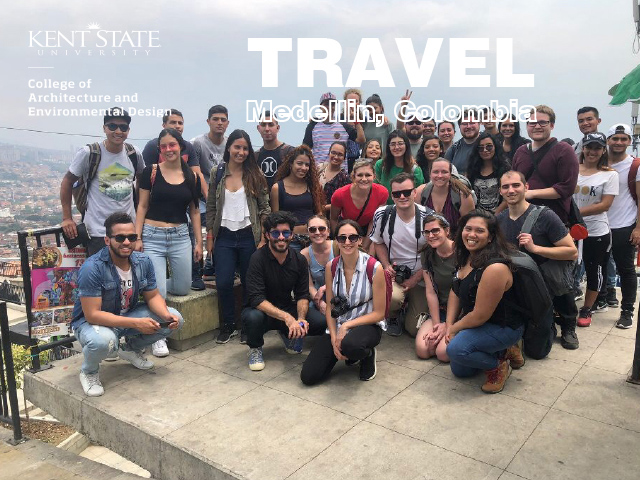
Through global partnerships, CAED graduate students gain a deeper understanding of the shared challenges and opportunities facing cities both in Northeast Ohio and around the world. The International Design Exchange (INDEX) Studio is a Kent State University, College of Architecture & Environmental Design (CAED) graduate-level architecture, landscape architecture and urban design studio established to build an understanding of urban issues through comparative analysis and international travel between Cleveland and other cities throughout the world.
In recent years, Landscape architecture students have worked with students and faculty from Tecnológico de Monterrey in Querétaro, Mexico, as part of developing long-term partnership with their Architecture and Urban Design Programs. Students have considered urban landscape issues common to both Mexico and Cleveland. Since the program's inception, studios have included an annual opportunity to travel to and engage regional-national-international destinations for educational enrichment. Recent trips have included Buffalo, Chicago, Detroit, Erie, Pittsburgh, St Louis, New York City, Medellin, Colombia, Queretaro, and Mexico City, Mexico.
Outreach
Every year, outreach with neighborhoods happens in the Urban and Regional-based design Studios, which hosts a community charette project or workshop. Students interact with neighborhood stakeholders and allied professionals that have included various Cleveland neighborhoods.
Each year the Cleveland Urban Design Collaborative conducts a regional charrette, with students participating in an intense 2-4 day planning and design exercise. Charette sites have included neighborhoods in the cities of Akron, Youngstown, Detroit and Cleveland.
Highlighted Events
Every semester visiting critics and lecturers visit the Cleveland studios. The CUDC hosts a rich annual lecture series, bringing in practitioners and theorists from across the country. The space also hosts exhibitions annually
In 2021, the landscape program participated in the Landscape Architecture Foundation Superstudio; providing a rich experience for students in a vertical studio teaching model. In 2023, students in the program participated in The Cultural Landscape Foundation 'What's out There Weekend, Cleveland' (WOTW-CLE) serving as volunteers for tours of historic sites. Program Coordinator Cat Marshall had been a part of the planning committee for this event since 2018.
Student Honors:
The Cultural Landscape Foundation Nominated Olmstead Scholar Program
Aya Keskeso was one of three finalists for the international 2024 National Olmsted Scholar. Aya received a $5,000 award for her work. Our first Olmsted Scholar was Lama Tawk in 2019, followed by Maci Nelson 20', James Sasser 21', Amanda Mumford 22', Saba Tajali 23', and Morgan Mackey 25'.
National ASLA Student Awards
In the Fall of 2025 Morgan Mackey (25') won the prestigious National ASLA Student Honor Award in the General Design category, for her Spring 2025Masters Project in Landscape Architecture: Riverfront Stitch: Mending Cleveland's Industrial Valley.
OCASLA Student Awards
Since 2019, our students have been recognized annually for academic achievement and studio design work through the Ohio State Chapter of ASLA's Student awards competition:
2025 Ohio ASLA Student Honor Award in recognition of outstanding academic achievement for her Studio Project "Perched on Happiness" Morgan Mackey (25)
2024 Ohio ASLA Student Honor Award in recognition of outstanding academic achievement for her Studio Project "Comfort for All while Climate and Homeless Populations Rise" Aya Keskeso MLA (24)
2024 Ohio ASLA Student Honor Award in recognition of outstanding academic achievement for her Studio Project "Lake Erie Marginal Freshwater Park" Asmita Dahal MLA (24)
2023 Ohio ASLA Student Honor Award in recognition of outstanding academic achievement for her Studio Project "Tree Stories: Community-Driven Design to Expand Cleveland's Urban Tree Canopy" Morgan Mackey MLA(25)
2023 Ohio ASLA Student Merit Award, in recognition of academic achievement for her studio project
"Green Recolonization" Saba Tajali, MLA (23)
2021 Ohio ASLA Student Honor Award in recognition of outstanding academic achievement for his studio project "The Revitalized Valley" Brendan Alcorn MLA (22)
2020 Ohio ASLA Student Honor Award in recognition of outstanding academic achievement for his studio project. "Maritime Emergence" James Sasser MLA (21)
2019 Ohio ASLA Student Merit Award, in recognition of academic achievement for her studio project
"Bat Camp" Katherine Kelleher MLA (19)
Program Information:
The program consists of a 3-year option for students with minimum design background, and a 2-year program for those eligible for advanced placement. The program consists of a sequence of either four or six 6CH design studios (depending on placement). Coursework consists of complementary subjects including those pertaining to visualization techniques, theoretical understanding, technical skills, and ecological knowledge. Student also have the opportunity to take 'cognate' electives that address a range of topics pertaining to the degree. Students graduate with 60Ch from the advanced placement sequence, or 72 CH hours in the three-year sequence. The program is LAAB accredited and STEM designated. Interested students may also consider completing a dual degree with the Masters of Urban Design program (also co-located at the Cleveland studios).
The program is offered in the heart of Cleveland (Playhouse Square) at Kent State's Cleveland Studios. The Cleveland Studios are located on the upper floor of the historic Cowell & Hubbard Building. The space was renovated by local design firm Westlake Reed Leskosky. Their approach was to reveal the history of renovations/alterations of the building by leaving many of the architectural elements, including raw concrete floors and plaster walls, exposed and intact. This creates an environment conducive to iterative and integrated design.
The Cleveland Studios are also home to several of the College of Architecture and Environmental Design (CAED) graduate programs as well as the Kent State's Cleveland Urban Design Collaborative (CUDC). The CUDC is an innovative, non-profit urban design practice committed to a sustainable, vibrant and inclusive urban future. The combination of Landscape Architecture, Urban Design, and the CUDC provides a rich context for complementary, multi-scalar integrated pursuits relating to the built environment.
Studio Culture
The CAED promotes a positive and respectful learning environment through the fundamental values of optimism, respect, sharing, engagement and innovation among the members of the student body, faculty, staff and administration. The CAED encourages students and faculty to appreciate these values as guiding principles of professional conduct. Although expectations are high, the CAED recognizes a balanced life and well rounded university education are critical for each student's personal growth.
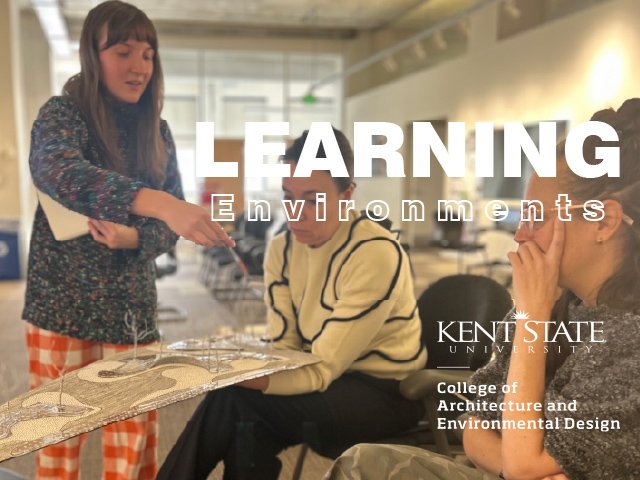
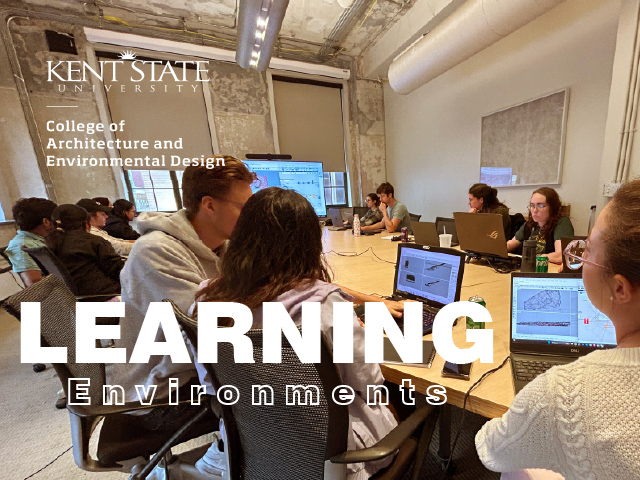
CAED studios are classroom environments which foster independent and collaborative inquiry, the acquisition of knowledge and management skills, and the establishment of a strong work ethic to enhance students' professional growth. Peer and faculty review within studio stimulates questions, strengthens dialogue, supports critical and creative thought, and promotes the discovery and application of new knowledge. Studio fosters design thinking through research and is a forum for design innovation and exploration with the goal of improving quality of life. CAED studios encourage life-long learning through establishing foundations in design thinking, research habits and the integration of life experiences in the pursuit of excellence in design
Work Spaces
All workstations are wired into the computer network. All workstations are equipped with an MDF work
surface. Students are provided with a monitor at their workspace. The broader work area includes exhibition and pin-up spaces, library facilities, conference and meeting rooms, as well as a fabrication lab. Students are able to access additional lab and library facilities at the main Campus in Kent.
Bicycles
We encourage you to ride your bicycles to the Cleveland Studio.